
How to Calculate Sales Conversion Rate & Lead Value

“If you can’t explain it to a six-year-old, you don’t understand it yourself.”
~Albert Einstein.
When you understand how sales conversion rate is calculated, and what a new lead is actually worth, you can direct your marketing efforts more sensibly without throwing your money away on advertising that doesn’t bring a return on investment (ROI).
I’m going to show you exactly how business owners (or marketers) can easily figure out:
- How to calculate conversion rate
- What your lead value is
- How many leads you need each month to stay afloat
- How much you should pay for advertising
If you are a business owner and you don’t have a handle on how to calculate these metrics, then you are likely just shooting from the hip, trying different things without really knowing what the true ROI is. That changes starting with this next step.
It all Starts With Tracking
You need to start keeping track of your leads and how you acquire them. It doesn’t require much effort, but it’s critical and it needs to be part of your process. Luckily I have a free resource for you at the bottom of this article.
I suggest you download my inquiry tracking spreadsheet and start tracking your leads. If you’re not tracking your leads, you have no point of reference and you’re swinging in the dark.
What is a Lead?
In marketing terms, a lead is someone potentially interested in purchasing your product or service. Some leads are going to be better than others.
A “hot lead” might be more qualified (more ready to buy) than say a “cold lead” that needs more convincing before pulling the trigger. For this reason, a hot or warm lead would be understandably more valuable to you than a cold lead… But how valuable?
We’ll explore the value of a lead more in-depth in a bit, but first, let’s talk about conversions.
What is a Conversion?
A conversion is any action that you define. It could be a purchase, an old-fashioned phone call, contact form submission, newsletter signup, social share, a specified length of time a visitor spends on a web page, playing a video, a download, etc.
Many of the small businesses that I meet only have a gut sense of where their new business comes from because they haven’t been tracking conversions.
Knowing your conversion rate(s) is the first step in understanding how your sales funnel is performing and what marketing avenues are giving the greatest return on investment (ROI).
Conversion Rate and How to Calculate It
Once you have defined what conversions you want to track, you can calculate the conversion rate. For the purposes of the following example, let’s call a conversion a sale.
Even if you’re still in the dark ages without a viable website, as long as you are tracking the number of leads you get and the number of resulting sales (conversions), you can calculate your conversion rate like so…
Conversion Rate = Total Number of Sales / Number of Leads * 100
Example: Let’s say you made 20 sales last year and had 100 inquiries/ leads. Your sales-to-lead conversion rate would be 20%.
If you’re tracking conversions from website leads, your formula looks like this:
Conversion Rate = Total Number of Sales / Number of Unique Visitors * 100
Example: If you made 20 sales in a month and you had 2,000 unique visitors to your site, your conversion rate would be 1%.
What is The Value of a Lead?
The value of something is what it’s worth to you. If you sell lawn irrigation systems at an average price of $2,000 installed and you turn a lead into a sale, then that lead is worth $2,000 to you.
However, we know that not every lead you get will end in a sale. In reality, you might only turn two out of 10 inquiries into a sale. That would make your conversion rate 20% (2/10 * 100 = 20).
That means you can expect to generate about $4,000 from your 10 leads (2 sales @ $2,000 ea). That’s because we know on average you are closing 2 out of 10 sales, a 20% conversion rate. This means that the value of one lead is actually $400 (4,000/10).
Here’s the formula:
Lead Value = Value of Sale / Number of Leads
The previous example is a bit simplistic and you can get much deeper with this stuff. As we discussed earlier, some leads will be more qualified than others and we will also want to look at the actual profit – not just the revenue. More on that in a minute.
Why The Value of a Lead Becomes Useful
When you know the value of a lead, you can determine how many leads you need each month to sustain your business and how much you should pay for advertising. This is true whether you use pay-per-click (PPC) or offline advertising, like mailers or print ads.
Conversions Needed = Desired Revenue / Lead Value
Example: Let’s say you need to generate $15,000 per month to float your irrigation business. Based on your conversion rate of 20% (2 sales / 10 leads x 100 = 20) from the previous example, you already know that each lead is worth about $400 (4,000/10).
This means, you would need about 37-38 leads per month (15,000 / 400 = 37.5) to make about 7-8 sales ($2,000 ea) and generate $15,000 in revenue.
(Note: This is a very simple example using revenue generated. A more accurate option would be to use the profit generated by sales and not just the revenue, but many businesses have difficulty defining this number so we use revenue as a guide.)
Example: If each sale of $2,000 actually costs you $1,000 to deliver, the profit on each sale is really $1,000. To get a return on your “advertising spend,” you’ll actually need to generate 75 leads to reach your $15,000 monthly goal.
The math:
1 sale = $1,000 profit
Conversion rate = 20% (2/10 * 100 = 20%)
Average lead Value = $200 ($2,000 /10 = $200)
Leads needed = 75 ($15,000 / $200 = 75)
Even if you use revenue instead of actual profit, as long as you are constantly tracking these metrics, you will be able to make much more informed decisions.
Understanding your sales funnel can help you determine the number of leads you need to get each month, how much you can safely spend on advertising, and what you can expect in return.
How to Leverage Lead Value to Your Advantage
In the business world, things aren’t always so simple. Not all sales are going to be equal. Some sales will be a home run, and others won’t.
Also, the conversion rates will be different depending on the traffic source. You may find that leads generated by paid search convert better because you’ve been hyper-focused on your advertising, using keywords with extremely high commercial intent and/or targeting customers that are very local to you.
So with an average order value of $2,000, you might see something like this:
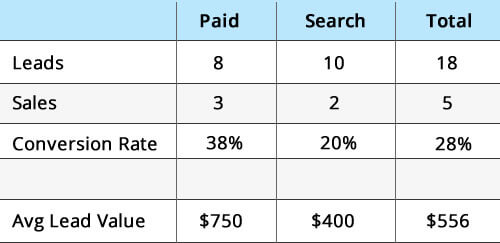
This shows that the value of a lead may be different depending on the lead source.
From this, you can see that a lead generated from your paid search campaign is worth more to you than a lead generated from an organic search.
If you have Google Analytics installed on your site (and you should), you can determine the average lead value and enter this into your analytics goal, then Google Analytics will do most of the hard work for you.
If you just stuff the average revenue value into the goal value, you’ll see highly inflated numbers that won’t make sense, as not every lead generated from the website will actually result in a sale.
Using a realistic lead value as your goal value will give you a clearer insight into how your website is performing.
Resources
Here’s a Google spreadsheet that I share with my clients so they can track leads. You’ll need to have a Google account if you want to make a copy and save it for yourself to use.
If you have any questions, feel free to leave a comment. I do my best to answer each and every one.

Have a Question?

If you have a question, leave a comment below or email us. We'll get back to you.